Showing posts with label CILIP. Show all posts

ARLG London and South East Visit to the Science Museum Library

I had an interesting visit to the Science Museum Library. The collection concerns the development and history of science, engineering and medicine from the fifteenth century to the present day. The Dana Research Centre and Library is located round the back of the Science Museum itself. We were welcomed by the librarian who told us a bit about the library.

The collection consists of around 6,000 books and journals, with much more located at the Science and Technology Studies Collection stored at Wroughton. Items from this collection, which is made up of over 80,000 books and periodicals, have been collected over the past century or more. There are various collections of rare books and donated archives, including the Patrick Moore Collection, the John Milne Seismological Library, the Comben Collection of works on animal husbandry, and trade pamphlets.


We were taken into the library itself, which is small but bright and airy. The pattern on the window was inspired by the dappled effect of sunlight through trees (reminiscent of Newton's discovery of gravity when an apple fell onto his head), and old-fashioned computer cards. The Library is open to the public, but not everyone can borrow.

Finally we got to look at some of the rare books and archives in the collection, which was fascinating. My favourite was the flight plan for the Apollo 11 moon mission, signed by Neil Armstrong and Buzz Aldrin.


ARLG London and South East Visit to the Shakespeare's Globe Library

I signed up for an ALRG London and South East visit to the Shakespeare's Globe library which I was very much looking forward to, as I missed out on a visit a couple of years ago. We met in the foyer and made our way to the library by going backstage, which was exciting in itself. The Library and Archive is in a temporary building, but in the next few years a purpose-built building is due to be constructed.

The Library and Archive services are staffed by a mixture of paid staff and volunteers. There is currently no librarian as the previous post-holder has recently left, but the archive staff were very helpful in explaining what was going on. The service is used mostly by academics as well as by those involved in Globe productions. Some actors are particular regulars.

The staff members got some things out for us to look at that emphasised the level of detail and research that went into the construction of the Globe over a number of years. My favourite was the letter from Eddie Redmayne to then-Artistic Director Mark Rylance, thanking him for the opportunity of performing at Middle Temple Hall but reluctantly declining to move with the production to the Globe as he wants to go back to university and finish his degree. There are other letters, pictures and legal records from the Globe's history, as well as books about theatres in Shakespeare's time.

I was really excited to get the chance to visit the library of one of my favourite places in London. Many thanks to ARLG London and South East for organising it.

ISG London & South East Visit to the National Theatre Archive

Recently I got to visit the National Theatre's Archive with the ISG London & South East.


The National Theatre has kept archives since it was founded in 1963, but it has only had a "proper" archive since the 1990s, and the current building (the NT Studio beside the Old Vic) has only been in use since 2007. The public reading room is open five days a week, and welcomes around 2,700 researchers each year.

The Archive covers three main areas: the first is the most popular and consists of cultural archives, such as photos, press reviews, stage management reports, programmes, posters, prompt scripts and the costume bible - including, in recent years, high definition photographs of costumes so that they can be recreated later on if need be. Many of these were used during the recent 50th anniversary celebrations. Recordings have been made since 1995 (except where contract negotiations don't allow it) - Platform recordings (where an actor or other theatre practitioner is interviewed in front of an audience) have been undertaken since the late 1980s. The cultural archive is fully catalogued.

The second part is the business archive, including meeting minutes, architectural plans et al: much of this is sensitive material. This archive includes the only plans of the Olivier's drum revolve, as well as information about the founding of the theatre  The third part is the external collections: the largest is the Jocelyn Herbert Collection, the archive of the acclaimed set and costume designer, consisting of around 6000 drawings, notebooks and even masks from one of her productions.

As the Archive is part of the Learning department, it can focus on being an academic resource, and not bringing in money. In any case, everything is in copyright so it cannot be commercialised. The Archive aims to support every level of learning: for those of school age, lots of plays the NT has produced are on the syllabus, and many pupils get the chance to take part in Archive Learning Days, in which they see the play and then explore the relevant resources.

The Archive works closely with the Digital Development department: an app has recently been launched with digitised archive content covering the "best" 50 plays performed at the National. The Archive uses the CALM software, and it is possible to search by production, actor, or a number of other criteria. The press often use the information in obituaries.

The Archive catalogue can be accessed online, and you can also email queries in from the website. Resources are used in exhibitions at the NT, and on the last Friday of every month, the NT Archivist and curator offer a tour of the exhibition in the Lyttelton Lounge followed by a handling session with materials from the Archive.

It's possible to go to the Archive reading rooms to watch a recording of an NT Live or other recorded production: recent popular productions have included Frankenstein and One Man Two Guvnors. I keep meaning to book an appointment to watch His Dark Materials - one day I'll get around to it!

Information Services Group Visit to the Zoological Society of London Library


The CILIP Information Services Group recently organised a visit to the Zoological Society of London Library, which I signed up for really quickly. The Library is located near London Zoo, and we gathered in the Council Room of the ZSL headquarters to begin the visit.

ZSL is the charity behind London Zoo and Whipsnade Zoo, as well as being a research institute funded by UCL. We were told a bit about the history of ZSL, which was established by Sir Stamford Raffles and Sir Humphry Davy in 1826. Impressively, women were admitted as fellows from 1827. The Council Room is full of pictures of individuals who have made contributions to the Society, including Prince Albert, who was the President from 1851-61, Harry Johnston (who discovered the okapi and many, many other animals), and Miriam Rothschild. Famous names in the visitors' book include Elizabeth II, Emperor Hirohito, John Paul Getty and Jackie Kennedy.


The Library, which can be reached online at library.zsl.org, is located upstairs in the building and is a rich resource of books and journals about zoology and animal conservation. It is open Monday to Friday, and is open to all for reference purposes, but only Fellows of the ZSL can borrow books. We got to wander around the Library and explore for ourselves. Naturally I went straight to the penguin section:


My favourite part of the visit was getting the chance to look at some of the archives and rare books that the librarians had very kindly got out for us. They included an early "Daily Occurrences" ledger, the very first Council Minutes (with the signature of Sir Stamford Raffles), the animal record card for Winnie the bear (the original Winnie-the-Pooh), newspaper clippings concerning an escapee eagle, and a medieval tome containing pictures of all kinds of weird and wonderful creatures (some real, some imagined).

Daily Occurrences 1865

Council Minutes

Animal record card for Winnie the bear

Goldie the golden eagle

Ulyssis Aldrovandi Monstrorum historia


I really enjoyed the visit, which was fascinating.

ARLG London and South East Visit to the Conway Hall Library

Conway Hall entrance. Photo: Wikimedia Commons

I visited the Conway Hall Library with ARLG. Conway Hall is a building near Holborn, London, owned by Conway Hall Ethical Society. It was opened in 1929, named after Moncure Daniel Conway (1832-1907), an anti-slavery advocate and supporter of free thought. These days it hosts a wide variety of performances, lectures and classes.

The Library contains the Ethical Society's collection, the largest and most comprehensive Humanist Research resource of its kind in the UK. Members of the Ethical Society can borrow books, and the Library is open to the public for research.

The Library is beautiful, as befits a resource contained within a Grade II listed building. The resources it contains include historical texts, artworks, music, pamphlets and archives. We got the chance to look at several items from the collection, including records of previous lectures and events held within the building.

As well as looking around the Library, we also got a tour of the building as a whole. The lecture hall is particularly impressive.

I enjoyed the chance to look around such an interesting and unusual library.

ARLG Southern British Library Tour

Recently I went on a visit to the British Library organised by ARLG Southern. The visit comprised a library tour, which really interested me because although I have visited the BL several times, it's always been as a visitor to the exhibitions: I'm not a member and I've never been in the reading rooms or behind the scenes.

The British Library Piazza. Source: Jack1956 on Wikipedia
The British Library, which is a relatively new institution that only came into being during the second half of the twentieth century, is the national library of the UK and the largest library in the world in terms of items catalogued. The building holds around 170 million items from numerous countries and in every language in the world. Information is held in multiple formats: print books and ebooks, manuscripts, journals, newspapers, magazines, audiovisual recordings, playscripts, patents, databases, maps, prints and drawings. The collections include around 14 million books, and the Library holds ancient historical items dating back as far as 2000 BC.

British Library Foyer
The Library is a Legal Deposit Library (the others are the Bodleian at Oxford, the University Library at Cambridge, the Trinity College Library in Dublin and the National Libraries of Scotland and Wales), meaning that it receives a copy of each book produced in the United Kingdom and Ireland, including several overseas books distributed in the UK.

Our tour, which was delivered by a very knowledgeable and entertaining guide, began in the foyer where we learned about the library's beginnings. The BL originally started out at the British Museum: the famous Round Reading Room is where famous people including Marx used to study. The British Library Act of 1972 enabled the BL to be established in 1973, although materials were dispersed around London and around the country for several years. When deciding upon a location for the eventual library site, there wasn't much choice available: it would have to be within walking distance of the British Museum in Bloomsbury, so that the rarest and most valuable books could be carried there by hand, as they were not permitted to be transported on vehicles. Eventually the site at Euston Road was decided upon: located next to St Pancras Station, it used to be a goods yard.

The Library was designed by Colin St John Wilson, and the building has met with a mixed reception (apparently Prince Charles hates it, but the Queen is a fan). Looked at from the right angle, it resembles a ship. It was made a Grade I listed building earlier this year, so it is now recognised as a landmark of design: however it is not without its problems. Wilson spent so much of the Library budget on expensive marble, containing fossils, to be laid outside on the piazza (meaning that it is extremely slippery in the rain) that there wasn't enough left for decent shelving, resulting in some collapses as the second-hand shelves couldn't bear the huge weight of the books.

It is impressive, however, that most of the books are stored underground: the stacks run several storeys beneath the ground, stopped only by the tube that is even further down. The Fleet River also runs nearby, so that the lowest floor does flood on occasion.

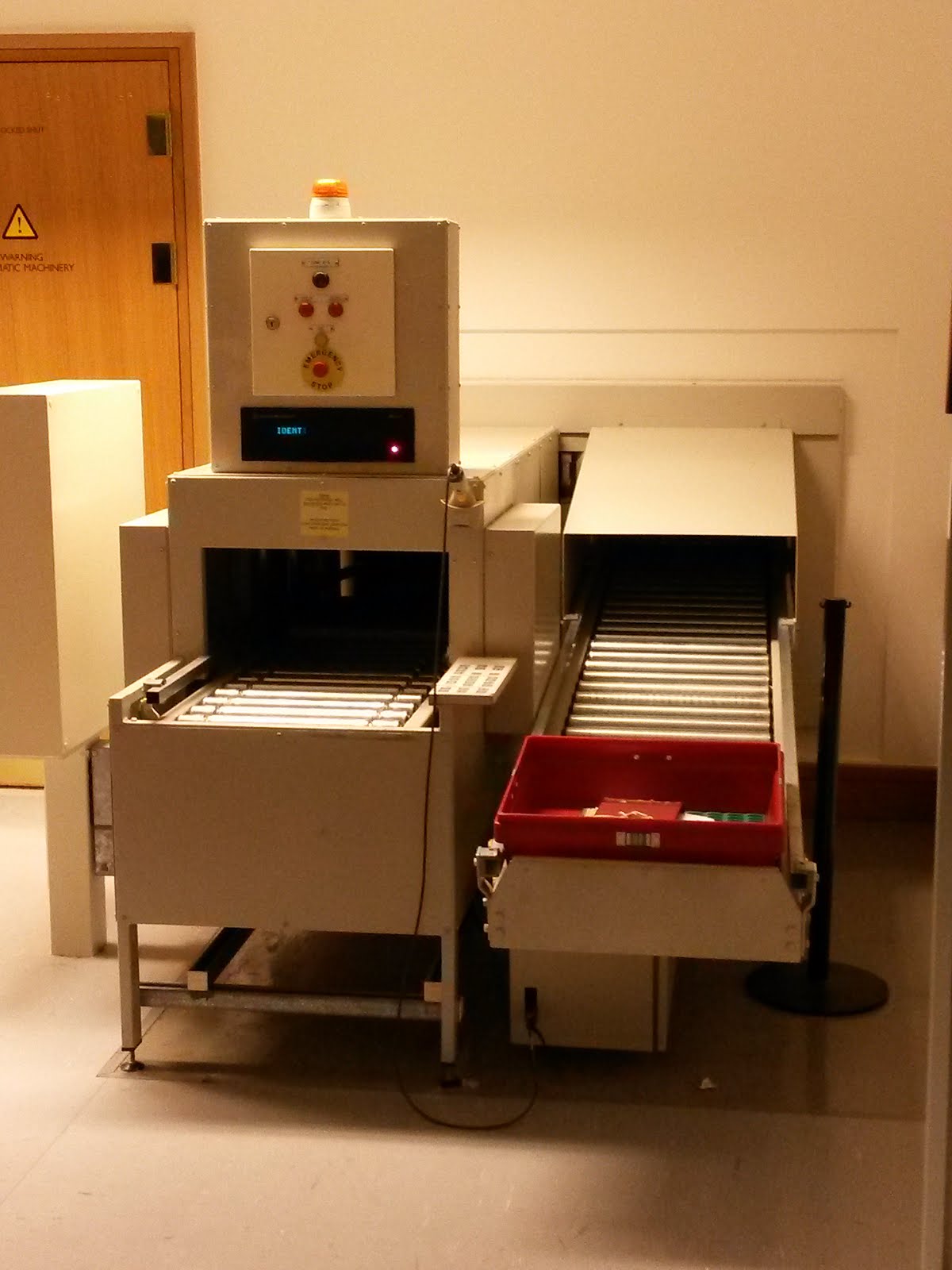
From the foyer we were taken to the Members' Area in which you can register to become a member of the Library. Anyone can register so long as they have the appropriate ID: you don't have to be an academic. Near here, there is a book handling system which delivers books users have ordered to the surface by means of a conveyor belt. Staff collect book requests, remove them from the shelves and send them up to the Library.

The book handling system
We went upstairs and were able to get a brilliant view of the King's Library, made up of 65,000 printed volumes and numerous pamphlets, manuscripts and maps collected by George III between 1763 and 1820. The glass tower was inspired by a similar structure in the Beinecke Library in New Haven, Connecticut.

The King's Library
From the old to the new: our next stop was the news room where readers can view newspapers and watch a live news feed. We explored the Library considerably, taking a look at the many busy - but extremely quiet - reading rooms.

Reading Room
Before leaving, we had a quick look at a Library video in one of the quietest corners of the building - left "unfinished" to show off the brickwork.


I really loved my tour: I learned a great deal about the British Library that I hadn't known before. Public tours are available and I do recommend signing up.

CILIP in Surrey Visit to St Paul's Cathedral Library

On Tuesday I took the afternoon off work to attend a CILIP in Surrey visit to the Library at St Paul's Cathedral. I actually looked at cathedral libraries and archives for my Masters dissertation, so I was really excited at getting the chance to see one. We were shown around by the Librarian, who took us up to the Triforium level behind the South West Tower, where the Library is located.

The original Library was destroyed in the Great Fire of 1666: though it was not housed in the Cathedral itself, it was located nearby, and fell victim to the blaze. A few manuscripts were saved, however, and were taken to the new Library, which now contains over 30,000 items. The Library is located in a room designed by Sir Christopher Wren, and the wall carvings make reference to the ecclesiastical subject of the tomes contained within. The Library's collections, which relate to Wren, the building of the new St Paul's, the history of the Church and the Church in the city, can be used by anyone who needs to make use of them.

In some ways the visit was more of a behind-the-scenes tour, as we got to see parts of St Paul's hidden from the average visitor, including the gallery at the back used for TV cameras during special events, the collection of historic fonts, and the large model of one particular design for St Paul's. It was fascinating to be able to learn about this unique library and the space in which it is housed.

ARLG London Visit to the RADA Library

I signed up to the ARLG visit to the RADA Library as I love the theatre, and thought it would be very interesting to have the chance to explore the library of one of the most famous actor training grounds. The Library is located at 18 Chenies Street, London, WC1E 7PA, very near in fact to the CILIP headquarters. It was established in 1904, initially via donation, including some from Bernard Shaw. In 1995 the Library was moved to this purpose-built space. In recent years, a cataloguing programme has ensured that all essential stock is now catalogued.

The Library has over 40,000 items including more than 12,000 plays, which form the core of the Library's service and are sorted, in A-Z order by author, on shelves in the middle of the space. Other books relating to particular authors, such as biographies, are shelved with works by that author, while other supporting material such as history and acting/directing manuals are shelved separately. The Library also has a selection of DVDs and videos, a music collection and links to digital resources including Drama Online, Digital Theatre and the RADA Accents Archive.

We were given a talk by the Library Manager, James Thornton. He explained that the Library is for the use of staff and students, with full-time students able to borrow up to 8 items at once. Books must be returned or renewed within 4 weeks. The Library is open six days out of seven during term time, including some late evenings. A cash deposit is required from students before they are able to borrow, which I thought quite surprising. External researchers are discouraged, as the resources are there primarily to support RADA students: they can use them if needed but are charged £10 per day.

After a look around the Library, we were shown some of the archives: RADA has registers of all students dating back to its founding, and we were able to see some of these including the entry for John Gielgud. It's exciting to think how many well-known actors have passed through RADA's - and the Library's - doors.

Thanks to RADA and ARLG for a fascinating visit.

Registering for Chartership

It seems fitting that I mark my 100th post on this blog with the announcement that, after months of thinking about it, I've finally registered for Chartership. I've found a mentor, attended a Professional Registration Workshop at CILIP, and paid my fee. I had my first telephone meeting with my mentor this morning: she seems lovely and I'm confident that we will have a good working relationship.

My first task is to complete the PKSB before our next meeting at the end of October. I'll write another post then on how I found the process.

ARLG London and South East Visit to the Wallace Collection Library and Archive

Earlier this week I was fortunate enough to participate in a visit to the Wallace Collection Library and Archive, organised by ARLG London and South East. The Wallace Collection is located within Hertford House, near Oxford Street in London, and is an impressive collection of paintings (particularly 18th century French work), furniture, porcelain and arms and armour. It grew from the private collections of the first four Marquesses of Hertford, and was bequeathed to the nation by Lady Wallace (widow of Sir Richard Wallace, son of the fourth Marquess) in 1897.

The Library began as a research library for curatorial staff, though it is now open to the public by appointment. It contains around 20,000 books, periodicals and exhibition catalogues relating to the artworks in the collection, as well as the De Walden collection of rare fencing books, which it holds on long-term loan. The Archive has files relating to the history of the collection and related material. Both the Library and Archive employed professional staff only comparatively recently.

We were taken on a tour of the Library, which is more complicated than it sounds: the "proper" library is in the basement, but there are other rare books in a cabinet within the museum, and more on the top floor within staff offices. Like many libraries there is a problem with lack of space, and staff also have to face challenges from members of curatorial staff, who like to have "their" books with them. Like many museums, the Library is not always seen as a priority - museum concerns take centre stage. However, despite this the Library is doing well, with the collection almost fully catalogued. I really enjoyed this fascinating visit.

CILIP South East Visit to the Inner Temple Library

I visited the Inner Temple Library with CILIP South East. The Inner Temple is one of the four Inns of Court, the others being Middle Temple, Gray's Inn and Lincoln's Inn. The Inns are unincorporated associations which have existed since the 14th century, and majorly contribute to the recruitment, training and professional life of barristers. They hold the exclusive rights to call candidates to the bar of England and Wales.

The Library is mainly used by practising barristers, though it is occasionally used by students. It is used by members of all four Inns of Court: each Inn's library specialises in a different kind of law so that the books are not duplicated, a sensible arrangement. The Library itself is very attractive, a calm, quiet place in which to work.

LIHG Visit to The Caird Archive and Library at the National Maritime Museum


I signed up for a CILIP Library and Information History Group visit to the Caird Library at the National Maritime Museum. The Library is a research library that specialises in maritime history, and holds the most extensive maritime archive in the world. The visit included a talk on the Library and its collections as well as a tour of the reading room and archives.

Introduction
We were met at the front desk and taken to the seminar room where Gareth Bellis, the Library Manager, told us about the history of the Library. From 1937 until 2011 the Library was organised under one design, and was opened to the public in 1980. In 2011 a new library opened as part of the museum extension, including an open space as well as archive stores. The new library allows up to 46 readers, as opposed to 16, to work in the building.

The Collection
The collection is made up of many and varied items: manuscripts and original documents, including personal papers; admiralty records and business collections (such as the archive collections of P&O); Board of Trade deposits (e.g. Masters certificates); and atlases, maps and charts. The Library also holds printed materials including rare books dating back to the fifteenth century and modern books bought by the museum to assist research. Periodicals, ephemera and eresources complete the rich collection.

Facts and figures
We learned some interesting facts and figures: the Library has 12km of shelving, 60% of the materials are stored in the Sammy Ofer wing at the NMM and 40% are stored off-site. The Library receives approximately 5000 visitors a year, of which around 50% are academic, and 40% are interested in family history or general history. Around 200 written enquiries and 120 phone enquiries are received each month. The NMM has three catalogues in all, one for the archives, one for museum collections including maps and charts, and one for the library itself.

Treasures
My favourite part of the visit was when we got to inspect some of the treasures held by the Library. The NMM's links with the Royal Observatory are demonstrated by John Flamsteed's Historia Celestus, a "corrupt catalogue" published too early by Halley and Newton. Another interesting item was an edition of William Buchan's Domestic Medicine, which belonged to the HMS Bounty and ended up with the mutineers on Pitcairn Island.

An account of the loss of the Royal George at Spithead in 1782, as well as a lieutenants log and some memorial books made of wood from the wreck, were present, as well as a letter from Lord Nelson to Emma Hamilton written on board the HMS Victory on 24 August, 1803. A crew agreement from the Cutty Sark and Board of Trade certificates for Edward John Smith, later of the Titanic, were also present. My favourite item of all, though, was a book by Peter Halkett from 1848 describing the author's rather bizarre invention of a boat-cloak, or cloak-boat. As the name suggests, this oddity was designed to be worn as a cloak and deployed as a boat should an emergency arise requiring this.

Overall a really interesting visit - thanks to all involved.

ARLG London and South East Visit to the Royal Library at Windsor Castle

On Thursday June 26th I took part in an enjoyable afternoon visit to the Royal Library at Windsor Castle, organised by ARLG-LASE. I took the day off work and spent the morning exploring the Castle itself, before meeting the others at the Visitors' Centre in the afternoon, to be escorted through the grounds to the Library.

The Royal Library is the third such collection: the first two made their way to the British Library. It contains around 43,000 items, many of which were donated. The Library was built in the 1830s, in the suite of rooms that used to belong to Charles II's Queen (hence why, when you tour the Castle, you only see the King's chambers).

I was surprised to learn that Prince Albert had a hand in developing the Library: he apparently had an enthusiasm for organisation and cataloguing, insisting that the books should be organised by subject rather than size, introducing bookplates, and trying to get more shelf space (nothing new there then). These days, the Library is used rarely by researchers: there are only a few dozen per year, as to gain access you have to specify what you want to see, and it has to be something that isn't available, or else is very rare, anywhere else.

The Library has some amazing items, including Charles I's copy of the works of Shakespeare, the title page of which he annotated with 'better' titles to some of the Bard's famous plays. To my mind he displayed a distinct lack of imagination: for instance, he wanted to rename Much Ado About Nothing, Beatrice and Benedick. There are also miniature books which were originally sent for Queen Mary's doll house.

The collection contains volumes from across the rare books spectrum. Among the Library's incunabula is a volume of Wynkyn de Worde's Polychronicon of 1495, as well as a copy of the Nuremberg Chronicle. There is also a copy of Aesop's Fables, printed by William Caxton, from the later 15th century. More recent items include books printed by William Morris's private press, Kelmscott, and an edition of the Holy Gospels, published in Venice, which was a coronation gift to King George V from the Greek Patriarch of Jerusalem, and which has an absolutely stunning mother of pearl binding.

Plenty of other books are notable for beautiful or unusual bindings. Materials used to bind these books include velvet, lacquer, horn and snakeskin. An 1867 volume by William Perkins, woodcutter to the Queen, is about the legendary Herne's Oak in Windsor, and is bound in wood from that very tree.

Not all the items in the Library are books. There are prints by artists as distinguished as Leonardo da Vinci, random objects presented to the Royals over the years, and even a piece of the Berlin Wall.


I really enjoyed my visit, and the chance to see inside a library that is not normally open to the public.

ARLG London and South East Visit to the Linnean Society of London

There have been so many good library visits organised by groups already this year, and I've been able to go on quite a few of them. Last week I went on an ARLG London & South East visit to the Linnean Society of London.

The Society can be found in Burlington House in Piccadilly (near the Royal Academy); it is the world's oldest active biological society, founded in 1788. We were given a fascinating introduction to the history of the society, which takes its name from Carl Linnaeus (1707-1778), the Swedish naturalist whose collections form the backbone of the Society.

Our tour began in the Meeting Room, the equivalent of the room in the previous building where, over a century ago, Charles Darwin and Alfred Russel Wallace's paper on natural selection was presented. Portraits of the two now hang on the wall, while the current President conducts the meetings from a crocodile-skin chair. I was particularly interested to hear about Wallace: he has been largely overshadowed by Darwin, but he sounds like a fascinating character and was also a great believer in social reform.

We were then divided into two groups. My group headed towards the Library, where we got to see the beautiful Grand Reading Room, complete with galleries. The Library is a working research library which holds both historical and current materials. The Library continues to acquire materials, often those books published by members of the Society, the Natural History Museum, and Kew. There was an interesting display on Wallace, including the rolled-up skin of a python he shot on one of his expeditions, and his sketches and notes. The librarians had kindly got out a number of special items for us to look at, including some of Linnaeus' books and notecards.

Finally, we got to see the Linnean Collections, kept underground in a bomb-proof strongroom. Here we learned more about Carl Linnaeus and his work. It was fascinating to see early editions of his books and it was clear that he was considerably ahead of his time in many ways: for instance, his classification system for living things put humans next to apes - this was in the late eighteenth century. Some of his specimens, including butterflies and amazing beetles, are still on display.

Afterwards we headed back upstairs for tea, biscuits and a chat. Thank you to the staff at the Linnean Society for a fascinating afternoon.

ARLG London and South East Visit to the Architectural Association

On Tuesday 15 January I attended the CILIP Academic and Research Libraries Group (London and South East Section) visit to the Architectural Association Library. Located just round the corner from my workplace on Bedford Square, the Library is a hidden gem serving the needs of AA members and students.

Seated in the main Library room with its beautiful ceiling, we were given an introduction to the Library and its history by Librarian Eleanor Gawne. Founded in 1862, a few years after the AA itself was founded by some students dissatisfied with the current state of architectural education, the Library contains more than 45,000 volumes on the history of architecture, architectural theory, contemporary architectural design, building types, interior design, landscape design and supplementary subjects. The Library also holds journals and has a growing collection of e-journals and e-books.

I found the special collections particularly interesting. We were shown several volumes, including a Nuremberg Chronicle from the 15th century, donated by a former AA member. The designs and drawings in the architecture books were beautiful. After a break for tea and biscuits, we were introduced to the archives by Archivist Edward Bottoms. The archives contain material relating to the work of the AA, including architectural drawings and paintings, models and student projects, as well as the culture and history of the Association. Formal cataloguing began in 2010 and an online catalogue is imminent. The collections were fascinating – the highlight being the record of a festival run by AA students in Bedford Square in the Seventies, which involved an elephant, a rock band and fire-eaters in the Library!

I really enjoyed my visit to the Architectural Association. Thanks to all the AA staff and ARLG London and South East for sorting it.

CILIP in London Meeting: Swimming in Data: Records Research in the Digital Age

On Tuesday I attended another CILIP in London meeting at The Square Wine Bar, Tolmers Square, near Euston. Called Swimming in Data: Records Research in the Digital Age, Caroline Kimbell, Head of Licensing at The National Archives in Kew, gave a talk on how the digitisation of Kew's archives is changing the ways in which history is studied.

Caroline explained that there are around 180km of archives at Kew, most of which are handwritten. Only around 7% of these records have been digitised so far, and while some of this has been pushed forward in line with Government policy, much of it is commercially driven.

Caroline explained some of the ways in which digitisation has assisted with research in new and unexpected ways. Digital records enable teams to work more collaboratively in the search for information, and means that collections which previously lay dormant have been 'woken up'. For instance, medical historians can use records kept by ships' surgeons to find out more about disease, while historians and scientists can use logs from whaling ships to map the extent of the Arctic ice shelf at various points in the past. Royal Navy log books from the 1690s onwards are assisting climatologists, allowing them to study the recorded weather readings and map them on a scale impossible before digitisation.

Digitisation can help make documents accessible again. Damaged census returns from Manchester, which had become unreadable owing to exposure to damp, have been made visible thanks to UV and infrared light techniques.

In literature, digitisation means that writing can be studied in different and more scientific ways. For instance, it has become possible to search text for particular words and phrases to get a more general idea about writing in the past. Tags and keywords can be added to digital documents to assist future researchers.

This system is not, however, without its flaws. The tags and keywords added now reflect our own cultural priorities and may not be what future generations need or want to study. Caroline mentioned the example of law archives: records of past cases survive because those in power at the time felt that they were important.

I really enjoyed Caroline's talk, and am particularly glad that she mentioned the Old Weather project - this allows the public to help transcribe the weather reports mentioned earlier, and looks like a great deal of fun too.

CILIP in London Meeting: The TUC Collections at London Metropolitan University


Last Monday I attended another CILIP in London meeting at The Square Wine Bar, Tolmers Square, near Euston. At this meeting there was a talk on The TUC (Trades Union Congress) Collections at London Metropolitan University, given by librarian Chris Coates.

Background
The TUC Library Collections, like the Women’s Library (on which I have blogged previously), are located at London Metropolitan University. Unlike the women’s collection, however, the TUC materials are to remain at London Met thanks to a joint-funding initiative with the Trades Union Congress.

The Library was founded in 1922, uniting collections from the TUC Parliamentary Committee, the Labour Party Information Bureau and the Women’s Trade Union League, which contain materials dating back to 1868. The Collections moved to London Metropolitan University in 1996.

The Trades Union Congress has played a key role in the development of the welfare state, having assisted with the development of public health, education and social services. It established the Labour Party and continues to play an important role in the promotion and maintenance of employees’ legal rights.

The Collections
The TUC Collections offer a major resource for the study of trade unions, work and learning. They contain material in all kinds of forms, including books, pamphlets and periodicals. Among the resources included are the following:

  • Trade union and labour history journals
  • TUC publications
  • Trade union publications (including from overseas)
  • Documents on industrial relations, including strikes such as the 1926 General Strike
  • Items relating to political and labour history
  • Documents relating to other topics such as international affairs and women workers
  • Publications relating to the Labour Party


Archival documents also form part of the collections. The TUC Library contains the Workers’ Educational Association Library and Archive, a valuable resource for the study of adult and continuing education, as well as the papers of Marjorie Nicholson, who worked in the TUC International Department, and Gertrude Tuckwell, who was involved with the Women’s Trade Union League. In addition, the Labour Research Department Archive is located within the Collections and a number of press cuttings are also held. The Library also holds the manuscript of Robert Tressell’s novel The Ragged Trousered Philanthropists.

Digitisation Programme
In her talk, Chris discussed the Collections’ digitisation programme, aimed at opening up the collections to a wider audience. The programme aims to inspire adult learners, inspiring an interest in social and labour history and encouraging the exploration of resources, as well as improving general IT skills. The scheme also helps to prevent damage to the original valuable archives.

One example of the digitisation programme can be found at www.unionhistory.info, the location of The Union Makes Us Strong: TUC History Online. This site forms an online history of British trade union movement, and contains timelines, essays, video interviews and digitised images and documents, such as the 1888 register of the Match Workers Strike. These resources are valuable for the teaching of union history: they engage students and encourage them to examine and interpret primary sources.

Problems and Difficulties
Chris in her talk discussed some of the problems facing the digitisation programme and the collection as a whole. One key issue is the lack of funding. Any funding is sporadic, so only certain parts of the collection can be catalogued or digitised at any one time. Currently the majority of the collection is only listed on the card catalogue; only new acquisitions since 1999 and records for British trade union publications before 1980 are accessible via the London Met online library catalogue. This means users cannot access the information remotely, and makes it harder to find relevant sources.

Linked to the lack of funding is a lack of staff: only two full-time members of staff work in the Library, along with some occasional project staff when funds allow. There is a mixed level of IT skills, both among the target audience and Library staff, which make the digitisation projects and the maintenance of the website more challenging. Staff also have to compete with the mistaken belief that the library is closing: they have seen visitor numbers drop over the summer, but in fact the Library is well and truly open!

I really enjoyed this talk and I'm glad I attended. I'd never heard of the TUC Collections before finding out about this event, and I feel as though I've learned a lot.

CILIP Career Development Group National Conference: Together We Are Stronger


Last month I attended the CILIP Career Development Group National Conference in Birmingham, held on 18th July at Austin Court. It’s taken me this long to get around to blogging about it – one of the reasons being that I was slightly underwhelmed by the experience. On reflection, I enjoyed the day, and feel I did get something out of it – but at the time I felt as though there was something missing.

I’ve attended the last two New Professionals conferences and in both cases came away feeling excited and inspired. This year, there was one conference for both new and established professionals. This was a good idea in theory – bringing together professionals at different stages of their careers – but I’m not sure it was marketed very well. There were comparatively few people there and the event lacked the buzz I experienced at previous events. I wasn’t alone as several people I spoke to felt the same.

Throughout the day a choice of two sessions were offered for most of the time, with a couple of exceptions, including the keynote address. The venue was lovely and the food was amazing (got to get my priorities right!): I loved the pastries for breakfast and there was a great range of vegetarian food at the lunchtime buffet.

The keynote address, Developing our community of practice: learning together for a stronger profession, was delivered by Liz Jolly. Liz was an engaging speaker and talked about developing a community of practice and the importance of learning together. She spoke about how we define what a profession is: via regulation, a code of ethics, a framework of qualifications and the existence of a professional community. Liz emphasised the importance of the professional body and suggested that if you don’t like something, it’s best to get involved and try to change it from the inside. Appropriate to this conference, she also talked about the different qualities that new and experienced professionals bring to the profession and how they can work together to create a ‘bi-directional knowledge flow”.

After the keynote address it was time for the parallel sessions on the theme of Sharing Knowledge and Experience. I chose to attend Karen Davies’ talk on Producing the evidence for effective evidence-based librarianship. She discussed the difficulties of applied research in a LIS context when qualitative research is more common and there is no right or wrong answer. She also gave research tips such as the importance of deciding what you need before you start and choosing your question carefully, as well as the necessity of critically evaluating your evidence and reviewing your outcomes. As a comparatively recent graduate I was familiar with most of the concepts she discussed but it was useful to have them reinforced and it made me wonder whether I’d be interested in undertaking research in the future.

I understand that parallel sessions on the theme of Wider Professional Outlook were planned, but one of the speakers dropped out so everyone attended Patricia Lacey and Emma Gibbs’ presentation on Developing your own skills network. They talked about a collaborative group set up to allow information professionals to learn from their peers and gain new skills. Participants have been able to engage in knowledge sharing, job shadowing and mentoring and gain benefits such as new skills to add to their CVs. Patricia and Emma gave tips such as the importance of planning and using diferent methods, such as email, to communicate in between face-to-face meetings and the importance of using feedback. The next theme of the day was Collaboration & Partnership and I attended Creating collaborative CPD opportunities delivered by Suzanne Tatham and Joseph Norwood. They spoke about their experience in a sub-branch of CILIP in Sussex, organising events such as a Brighton Library TeachMeet.

After lunch, Michael Martin from CILIP spoke on the Future Skills Project and discussed the new inclusive qualification framework. I had heard a bit about this but still found it interesting as it is highly relevant for me and for the profession as a whole. I was pleased to see that CILIP have taken on board feedback and the generic skills section is smaller than it was. Different skill areas are coloured differently on the wheel too which makes it easier to use. The new framework is due to be launched in September at the AGM.

Out of the two workshops on offer, I chose to attend the one on Career paths and networking led by Jeremy Clarke from Sue Hill Recruitment. The key concept I took away was the idea of finding security in your employability, rather than your employer. Jeremy made some useful suggestions including researching emerging skill requirements and recording, reflecting on and evaluating everything. He argued that to maintain enthusiasm and energy it is best to start the process when you are feeling particularly enthused, such as just after a really useful event.

Continuing the theme of Collaboration & Partnership, I attended Cross-sectoral staff development with CLIC by Kristine Chapman and Karen Pierce. CLIC stands for ‘Cardiff Libraries in Cooperation’ and it is run for all staff working in libraries in Cardiff. It runs mostly free, inclusive events including networking and 23 Things meetups. Finally, I attended Rebecca Dorsett’s presentation, Shelving together: collaborative working throughout different library environments, which had probably the best opening picture of the entire conference. Rebecca has worked in several different library sectors and in her talk she illustrated ways in which lessons could be learnt from one sector and applied to another: for example literacy schemes used in prison libraries could work in public libraries too, and work undertaken by many rare books and special collections staff to promote their collections and embark on digitisation projects could also be used in other libraries. Rebecca’s presentation was probably my favourite of the whole day: her enthusiasm really came across and I found what she had to say really interesting.

I do wish I'd written this earlier, as my memory is a bit hazy, and though I made notes, my handwriting is so dreadful that I had some difficulty deciphering them. Having said that, I do recall that generally, although my experience didn't compare to the previous New Professionals conferences I've attended, I did take away some useful points. All in all it was a worthwhile day and I enjoyed meeting up with old friends and people I’d previously only known on Twitter. I also spoke to a few new people, which I was pleased about. One thing at least hadn't changed from previous years: I was one of the last people in the pub at the end.

CILIP in London Meeting: The Women's Library


Last week, I went to a CILIP in London meeting to hear a talk about the Women’s Library, held in The Square wine bar near Euston. The talk was given by Dianne Shepherd, Information Librarian.

I’d heard of the Women’s Library but had never visited or found out any more about it, so I thought the talk would be an interesting experience. The collection has been designated by the Museums, Libraries and Archives Council as being of outstanding national and international importance, and documents women's lives through the ages, from education, health and family through to suffrage and the feminist movement. The collection is primarily concerned with Britain, but contains some international material as well.

History of the Library
Dianne began by discussing the history of the Women's Library. It was founded in 1926 as the Library of the London Society for Women's Service, growing out of the women's suffrage movement. Initially it was a subscription library and it's collections came largely from donations. It was renamed the Fawcett Library in 1953 in honour of Millicent Fawcett, leader of the London women's suffrage organisation.

In 1977 the Library moved to City Polytechnic, now part of London Metropolitan University. It moved into a new purpose-built building in 2002 thanks to a grant from the Heritage Lottery Fund, giving it a visibility and a distinctive brand that it previously lacked.

The nature of the collection
Dianne explained that the collection was varied and consisted of a number of different types of items: books from as early as the sixteenth century, newspaper cuttings, personal archives from the nineteenth century onwards, and a museum collection of objects from the eighteenth century onwards. More recently, materials have included audiovisual items. The materials are interdisciplinary in nature and can be accessed by anyone – the general public as well as academic researchers.

One of the most intriguing items in the collection, according to a booklet passed around by Dianne during the talk, is woman's suffrage activist Emily Davison's return ticket to the Epsom Derby, which raises the question of whether her death under the King's horse was suicide or a tragic accident. Why buy a return ticket unless you intend to come back?

The importance of professional staffing
Dianne explained that when the new building first opened, five readers in one day seemed like a lot. Now, that would be a quiet day: there were 4161 visits and over 14,000 enquiries during 2011. A professional programme of outreach and development has helped to widen access to the collections, while curated exhibitions display older, more fragile material not generally accessible to readers. The existence of the professionally-staffed Library has allowed a reading room service to be offered to users and enabled more collections to be made accessible. The Library does make use of volunteers, and Dianne acknowledged the valuable contribution that they make: but emphasised that they are not intended to replace professional staff, rather they concentrate on more routine tasks that Library staff do not have the time to undertake.

The Library still relies heavily on donations, but a formal acquisitions policy is in place and team meetings discuss proposed donations and the most appropriate place for them - the library, archive or museum collection.

The Library under threat
A few months ago, London Metropolitan University, currently responsible for the Library, stated that it was seeking a new custodian. This is partly for financial reasons and partly because the Library no longer aligns with the aims of the University. I found this part of Dianne's talk, touching on the bids under way and maintaining morale in the face of the TUPE process, interesting as my workplace is currently going through that same process (although in a far less stressful, for me, context). A decision is due in the autumn and it is hoped that a suitable custodian will be found: after all the work of the past decade it would be such a shame if it was all for nothing.

Conclusion
I found the talk extremely interesting and learnt a lot about a library of which I had known little. I left convinced that the Women's Library is a hugely valuable resource which should be maintained for all users. I hope it succeeds in finding a suitable custodian and I hope to pay it a visit soon. Its predicament raises worrying issues about the priorities of universities in these financially challenging times, and I'm sure this won't be the last collection to come under threat.

On another note, I really enjoyed chatting to people before and after the meeting, and was very impressed with the food! This was the first CILIP in London meeting I'd attended, and I hope to go to another soon.

Preserving a culture: scripts, digitisation and librarianship from Inner Mongolia


Last week I attended the International Library and Information Group (ILIG) Informal at CILIP headquarters, which took the form of a talk entitled Preserving a culture: scripts, digitisation and librarianship from Inner Mongolia. I’m not a member of ILIG and had never been to one of their events before, but this really appealed to me as it sounded so fascinating.

Professor Delger Borjigin, a Visiting Scholar at the Department of the Languages and Cultures of China and Inner Asia at SOAS, spoke on the history of Mongolia and the languages and scripts used by the Mongolian people, from the beginning of the Great Mongol Empire formed by Chinggis (‘Genghis’) Khan in 1206. He discussed the various scripts invented and used by scholars through the centuries, including phonetic scripts, classic Mongolian, and the Cyrillic script (still in use in Mongolia; the Inner Mongolia Autonomous Region uses classic Mongolian script). His presentation was illustrated with several examples of written Mongolian script. As a history graduate, I enjoyed this part of his talk in its own right, but its purpose was to demonstrate how important the development of language and writing is in the study of Mongolian history and culture.

Professor Borjigin then spoke about the projects he has been involved in as Director of the Catalogue Database of Mongolian Books (in classical Mongolian), and the Digitizing Program of Mongolian Documents, at the Library of Inner Mongolia University. IMU joined the Million Project of the China-America Digital Academic Library (CADAC) in 2003 and has been digitising the ancient books of Mongolia and the modern books of China.

Staff on the project faced difficulties not generally faced by staff in Britain. Many older Mongolian books were produced on long scrolls: rather than scan sections separately like the pages of a typical Western book, the library imported a scanner from Japan which allowed them to scan the whole thing at once. Other books are produced differently from Western-style books with spines: some older books come in Sanskrit style sutra bindings which are folios of unbounded sheets. The catalogue and full text databases have been completed and the plan is to have digitised two thirds of the Mongolian ancient books of IMU within the next three years.

I was also interested to hear about the collaboration between the Inner Mongolia Autonomous Region and Mongolia, in response to a question from a member of the audience. Professionals exchange visits each year to discuss ideas and share expertise: this works well as Inner Mongolia has greater knowledge of classic Mongolian script while Outer Mongolia has stronger expertise in Cyrillic script. Collaboration and co-operation are big in the UK so it was interesting to find that they are popular the world over.

Altogether I really enjoyed the evening and found it really fascinating, not only from a librarianship point of view but from a historical and cultural viewpoint as well.