16th Annual Durham Blackboard Users' Conference

The theme of this year’s Blackboard Users’ Conference, held on 7th & 8th January at Durham University Business School, was “Learning From Failure”, which was suggested by delegates from last year’s conference. The keynote was delivered by Eric Stoller, who addressed the issues of digital identity and failure on social media.

Blackboard themselves also addressed the conference, although they called their talk “Reflections on a shared journey” rather than examining the concept of learning from failure. They examined the changes that the system has undergone over the years and the needs of Blackboard today, including a resilient server, trained staff, backups and appropriate network access. These days the system is “mission critical” and users have higher expectations.

A Sessions: Is There A Place for Blackboard Collaborate in Blended Learning Design – Matt Cornock, University of York

This session looked at whether Blackboard Collaborate could be useful in blended learning – learning that mixes face to face and distance learning. It covered the issues that can be experienced with Blackboard Collaborate including loss of sound quality, connection reliability, issues with the launcher and whiteboard interaction. MC discussed a case study in which students on a creative writing programme used Collaborate to try and replicate the face to face environment. It was found that this didn’t work as the online environment could not facilitate the spontaneity and natural atmosphere of a face to face environment. Also, remote students by this time had already formed their own social groups for mutual support so they did not need to approach these sessions in the same way.

However, Collaborate has been proved to be useful for such functions as library tutorials and support, as well as group work, some individual tuition, teleconferencing and careers workshops.

B Sessions: Designing A Pre-Induction Course: Mistakes, Issues and Success – Steve Dawes, Regent’s University London

This session examined the issues faced by staff at Regent’s University London when designing a pre-induction course for students. The course was designed to streamline the induction process for students which can often be daunting.

The course was designed to be a simple student-centric platform with a single login so that all students could access it even if they did not yet have their own personal login details. It focused on the key information that students would need when arriving at university, including information about accommodation, visas and study skills. The students were not taught how to use Blackboard – it was hoped that they would be able to pick it up through completing this simple course.
The homepage was designed to resemble the University website so that students grew familiar with the structure of the website. There was only one course link to click on to get to the information they needed. There was an element of interactivity: e.g. a checklist entitled “Are You Ready?” consisting of a series of yes or no questions checking if students had everything they would need. There was also an interactive map of the campus.

987 of the trial students completed the final survey. The most popular elements were the introduction and the “Are You Ready?” questionnaire. In general there was a good student uptake with positive feedback, and a reduction in emails to student support. This was done for the Jan rollout and will be improved for the September cohort.

Future potential improvements include polls, Collaborate sessions, media content and group inductions.

C Sessions: Growing Pains: Preparing For A Teenage VLE – Andy White, University of Cumbria

This session charted the University of Cumbria’s use of Blackboard as their VLE platform since 2003. At the time, study was mostly campus based but videos would be filmed and posted out to distance learners. Students also had to send paper-based submissions through the post.
Over time there was a move to integrate Bb usernames and passwords with University ones, and they got the licensed mobile site in 2012. In 2014, Bb was listed by the University as “mission critical” for disaster recovery.

This year it was decided that every programme should have a presence on Blackboard. A benchmarking exercise was introduced in order to check whether courses were active, if they contained any broken links, or had any hidden content. An annual review is now planned to ensure that high standards are maintained.

D Sessions: Working With Students as Partners to Help You Identify and Learn from Your Mistakes: Developing a Pre-Arrival Study Skills Course for all Undergraduates – Sam Nolan, Eleanor Loughlin, Malcolm Murray, Elaine Tan and Jacquie Scollen, Durham University

After it was suggested that students wanted more contact before arriving at university, it was decided at Durham that a pre-arrival study skills course should be developed. A short 2-week course was trialled last summer, covering topics such as preparing for academic study, independent learning and digital literacy. A videographer was employed to film staff and current students talking about relevant topics. Other areas such as library services were also explored. The course will be rolled out to all students in the next academic year.

The course contains information about coming to Durham, preparing for arrival and transitioning to independent learning.  It also contains information about classes and reading materials, as well as support services such as library services. To date, the course has received 103, 576 views. Student feedback suggests that those using the course feel more prepared for their arrival at Durham.
The presentation explored mistakes the staff felt they had made and the steps they plan to take to rectify these. For instance, they felt that they should have involved students as consultants from the start of the project, and made risk management a priority earlier on.

E Sessions: The SPECTRE of Blackboard Design – James Leahy, Regent’s University London

This session looked at the syndrome of “Persistent Empty Courses” at Regent’s University – the problem of lecturers not making good use of Blackboard courses to enhance learning even though the offline course was excellent. In this example, the presenter added banners, logos and videos to the course to demonstrate the potential of online materials.

F Sessions: Establishing High Stakes Computer-Based Testing through Blackboard As A Supported Service: An Institutional Perspective On Key Challenges and Lessons Learned – Richard Walker and Andy Parkinson, University of York

This session looked at the growing use of VLEs for formal assessment and explored the ways in which staff at the University of York have coped with the challenges of implementing this. Exams on the VLE must be intuitive, flawless and fit for purpose, with a dedicated infrastructure and automated marking.

Staff were aware of possible issues that could arise, including loss of student data and multiple workstation failure. They took steps to minimize this, including creating separate exam accounts for students.

Some of the issues encountered included students being sent to the wrong rooms, and ongoing challenges with timetabling. One issue involved the randomization of questions – some students were shown the harder, essay-style questions first while others were given multiple-choice questions – this could be seen as unfair, so the issue was later rectified.

G Sessions: How I Have So Far Failed To Create A Fully Accessible VLE – Al Holloway, University of Northampton

Al Holloway’s presentation explored how he has tried to create a fully accessible VLE, but this has been difficult without the wholehearted support of all staff. Accessibility issues include Blackboard themes and layouts, video content, recorded lectures, documents and content authoring, and different browsers.  Some staff responded to his requests to look at making their material more accessible, but others made less of an effort. He emphasized the importance of gaining support from key stakeholders, and suggests implementing a method to audit accessibility.

H Sessions: Electronic Submission on Large and Complex Courses – Chris Boon, City College Norwich


This course looked at ways to manage the Grade Centre in Blackboard given the widespread use of electronic submission. These methods including splitting the class into groups, creating categories, and using Smart Views.

I found the conference really useful, and it was good to meet other people who work with VLEs. I picked up some useful pointers and learned a good deal.

Chartership - the Professional Knowledge and Skills Base

Towards the end of last year I finally took the plunge and registered for Chartership. I found a mentor and began to make plans. After many years of procrastinating, I was finally about to begin the process.

My first task was to go through the PKSB (Professional Knowledge and Skills Base) and pick out areas I thought I might like to develop. The PKSB looks really daunting at first, but remember, you aren't expected to do everything! I found blog posts about the process by WoodsieGirl and Steve Carlton, which were really useful in helping me work out exactly what I needed to do.

I began by going through the entire PKSB and giving myself a score for each area, as well as a score for my ideal skill level. I ended up with roughly three categories: areas in which I feel my skills are up to scratch; areas in which I don't have much expertise but which are not immediately relevant to my role and projected career path; and areas which are relevant but which are in need of improvement. This last category is certainly the most important in terms of Chartership.

Area of PKSB
3. Using and exploiting knowledge and information
3.3 Information retrieval
5. Information Governance and Compliance
5.3 Copyright, intellectual property and licensing
8. Literacies and Learning
8.6 Teaching and training skills
8.8 Virtual learning environments
11. Customer Focus, Service Design and Marketing
11.4 Service innovation, development and design
Other PKSB elements
Ethics and Values
Wider Library, Information and Knowledge Sector Context
Wider Organisation and Environmental Context

After some thought I settled on the categories above. I discussed them with my mentor to make sure I was on the right lines. I wanted to make sure I chose a variety of skills and knowledge areas from different areas, with a good mix of concrete skills and general awareness.

I already have some ideas of how I'm going to develop my skills, and I have made a plan of sorts - it's just a matter of sticking to it! One of my objectives was to attend the 2016 Blackboard Users' Conference in Durham, and I did that at the beginning of January, so I can tick something off my list. I've also completed a MOOC about literature searching. Next  up is a write-up of the conference, after which I need to tackle some reflective pieces.

My tips for the initial PKSB assessment are as follows:

  • Try not to get overwhelmed: remember, you don't need to aim for a 4 in everything - you only need to select up to 10 areas.
  • Ask for advice, or at least, try and and find out how others coped with the assessment: as I mentioned, I found the blog posts mentioned above very informative.
  • Discuss it with your mentor: either before, during or after your self-assessment. They can help reassure you that you are on the right lines.
  • Don't worry about getting your initial scores completely right - they are just estimates and you will not be tested on them.
Now to put my plan into practice...

The Wiener Library

Although I've worked close to The Wiener Library for the Study of the Holocaust and Genocide for several years now, I'd never actually visited. It wasn't until a colleague told me about the weekly library tours, which take place every Tuesday lunchtime, that I thought to visit. We ended up making it a bit of a work thing: three of us went one lunchtime, to be followed by the other two a week later.
The Library, formed in 1933 by Alfred Wiener, is Britain's Holocaust library and the oldest collection of its kind in the world. It holds over one million items, including illustrated and rare books, press cuttings, photographs and eyewitness testimonies.
Our tour included the main Library reading room, with considerable collections available on open access for the use of readers. Items stored elsewhere in the building, including photographs and fragile items, can be requested. Members of the public can use the Library, open on weekdays, free of charge, though first-time visitors do need to bring some ID. You need to become a member if you want to borrow books.
We were taken downstairs to view the stacks, and were able to see several fascinating items which our guide brought out to show us. One was a Nazi colouring book and another was a book of photographs of Hitler and assorted small children: both were bizarre and rather chilling. There were also some documents relating to Jewish refugees who came to the UK.
The Library runs a programme of temporary exhibitions on the ground floor. The current exhibition is Fragments of a Lost Homeland: Remembering the Armenian Genocide which is on until 25 February. This exhibition focuses on one particular family around 1915 who recorded their experiences before, during and after the genocide in letters, diaries and photographs.
The Wiener Library is well worth a visit, even if you don't need to use the research facilities. Tours run on Tuesdays at 1pm, and you can visit the temporary exhibitions during regular opening hours.

ARLG Southern British Library Tour

Recently I went on a visit to the British Library organised by ARLG Southern. The visit comprised a library tour, which really interested me because although I have visited the BL several times, it's always been as a visitor to the exhibitions: I'm not a member and I've never been in the reading rooms or behind the scenes.

The British Library Piazza. Source: Jack1956 on Wikipedia
The British Library, which is a relatively new institution that only came into being during the second half of the twentieth century, is the national library of the UK and the largest library in the world in terms of items catalogued. The building holds around 170 million items from numerous countries and in every language in the world. Information is held in multiple formats: print books and ebooks, manuscripts, journals, newspapers, magazines, audiovisual recordings, playscripts, patents, databases, maps, prints and drawings. The collections include around 14 million books, and the Library holds ancient historical items dating back as far as 2000 BC.

British Library Foyer
The Library is a Legal Deposit Library (the others are the Bodleian at Oxford, the University Library at Cambridge, the Trinity College Library in Dublin and the National Libraries of Scotland and Wales), meaning that it receives a copy of each book produced in the United Kingdom and Ireland, including several overseas books distributed in the UK.

Our tour, which was delivered by a very knowledgeable and entertaining guide, began in the foyer where we learned about the library's beginnings. The BL originally started out at the British Museum: the famous Round Reading Room is where famous people including Marx used to study. The British Library Act of 1972 enabled the BL to be established in 1973, although materials were dispersed around London and around the country for several years. When deciding upon a location for the eventual library site, there wasn't much choice available: it would have to be within walking distance of the British Museum in Bloomsbury, so that the rarest and most valuable books could be carried there by hand, as they were not permitted to be transported on vehicles. Eventually the site at Euston Road was decided upon: located next to St Pancras Station, it used to be a goods yard.

The Library was designed by Colin St John Wilson, and the building has met with a mixed reception (apparently Prince Charles hates it, but the Queen is a fan). Looked at from the right angle, it resembles a ship. It was made a Grade I listed building earlier this year, so it is now recognised as a landmark of design: however it is not without its problems. Wilson spent so much of the Library budget on expensive marble, containing fossils, to be laid outside on the piazza (meaning that it is extremely slippery in the rain) that there wasn't enough left for decent shelving, resulting in some collapses as the second-hand shelves couldn't bear the huge weight of the books.

It is impressive, however, that most of the books are stored underground: the stacks run several storeys beneath the ground, stopped only by the tube that is even further down. The Fleet River also runs nearby, so that the lowest floor does flood on occasion.

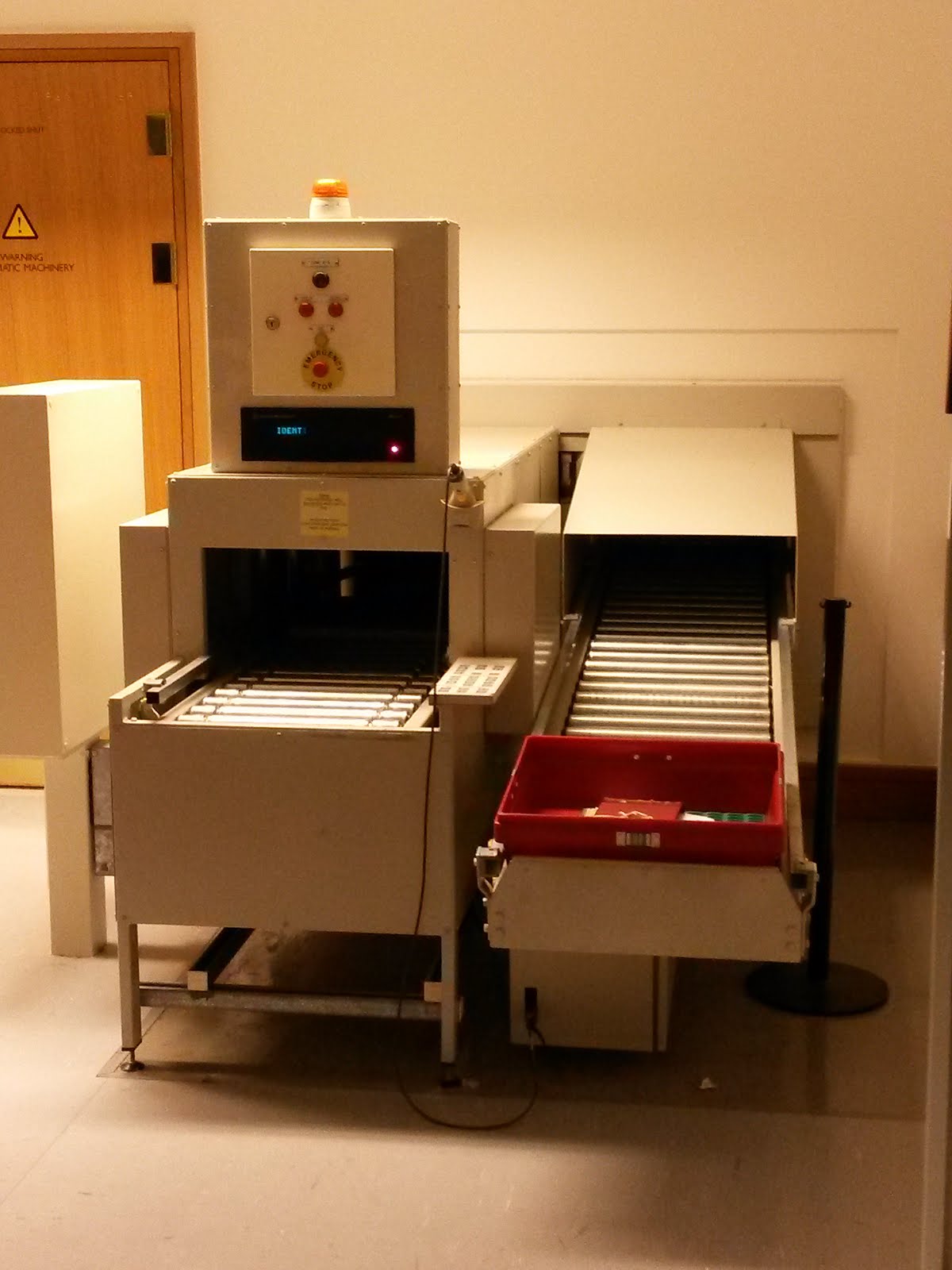
From the foyer we were taken to the Members' Area in which you can register to become a member of the Library. Anyone can register so long as they have the appropriate ID: you don't have to be an academic. Near here, there is a book handling system which delivers books users have ordered to the surface by means of a conveyor belt. Staff collect book requests, remove them from the shelves and send them up to the Library.

The book handling system
We went upstairs and were able to get a brilliant view of the King's Library, made up of 65,000 printed volumes and numerous pamphlets, manuscripts and maps collected by George III between 1763 and 1820. The glass tower was inspired by a similar structure in the Beinecke Library in New Haven, Connecticut.

The King's Library
From the old to the new: our next stop was the news room where readers can view newspapers and watch a live news feed. We explored the Library considerably, taking a look at the many busy - but extremely quiet - reading rooms.

Reading Room
Before leaving, we had a quick look at a Library video in one of the quietest corners of the building - left "unfinished" to show off the brickwork.


I really loved my tour: I learned a great deal about the British Library that I hadn't known before. Public tours are available and I do recommend signing up.

CILIP in Surrey Visit to St Paul's Cathedral Library

On Tuesday I took the afternoon off work to attend a CILIP in Surrey visit to the Library at St Paul's Cathedral. I actually looked at cathedral libraries and archives for my Masters dissertation, so I was really excited at getting the chance to see one. We were shown around by the Librarian, who took us up to the Triforium level behind the South West Tower, where the Library is located.

The original Library was destroyed in the Great Fire of 1666: though it was not housed in the Cathedral itself, it was located nearby, and fell victim to the blaze. A few manuscripts were saved, however, and were taken to the new Library, which now contains over 30,000 items. The Library is located in a room designed by Sir Christopher Wren, and the wall carvings make reference to the ecclesiastical subject of the tomes contained within. The Library's collections, which relate to Wren, the building of the new St Paul's, the history of the Church and the Church in the city, can be used by anyone who needs to make use of them.

In some ways the visit was more of a behind-the-scenes tour, as we got to see parts of St Paul's hidden from the average visitor, including the gallery at the back used for TV cameras during special events, the collection of historic fonts, and the large model of one particular design for St Paul's. It was fascinating to be able to learn about this unique library and the space in which it is housed.

ARLG London Visit to the RADA Library

I signed up to the ARLG visit to the RADA Library as I love the theatre, and thought it would be very interesting to have the chance to explore the library of one of the most famous actor training grounds. The Library is located at 18 Chenies Street, London, WC1E 7PA, very near in fact to the CILIP headquarters. It was established in 1904, initially via donation, including some from Bernard Shaw. In 1995 the Library was moved to this purpose-built space. In recent years, a cataloguing programme has ensured that all essential stock is now catalogued.

The Library has over 40,000 items including more than 12,000 plays, which form the core of the Library's service and are sorted, in A-Z order by author, on shelves in the middle of the space. Other books relating to particular authors, such as biographies, are shelved with works by that author, while other supporting material such as history and acting/directing manuals are shelved separately. The Library also has a selection of DVDs and videos, a music collection and links to digital resources including Drama Online, Digital Theatre and the RADA Accents Archive.

We were given a talk by the Library Manager, James Thornton. He explained that the Library is for the use of staff and students, with full-time students able to borrow up to 8 items at once. Books must be returned or renewed within 4 weeks. The Library is open six days out of seven during term time, including some late evenings. A cash deposit is required from students before they are able to borrow, which I thought quite surprising. External researchers are discouraged, as the resources are there primarily to support RADA students: they can use them if needed but are charged £10 per day.

After a look around the Library, we were shown some of the archives: RADA has registers of all students dating back to its founding, and we were able to see some of these including the entry for John Gielgud. It's exciting to think how many well-known actors have passed through RADA's - and the Library's - doors.

Thanks to RADA and ARLG for a fascinating visit.

Registering for Chartership

It seems fitting that I mark my 100th post on this blog with the announcement that, after months of thinking about it, I've finally registered for Chartership. I've found a mentor, attended a Professional Registration Workshop at CILIP, and paid my fee. I had my first telephone meeting with my mentor this morning: she seems lovely and I'm confident that we will have a good working relationship.

My first task is to complete the PKSB before our next meeting at the end of October. I'll write another post then on how I found the process.